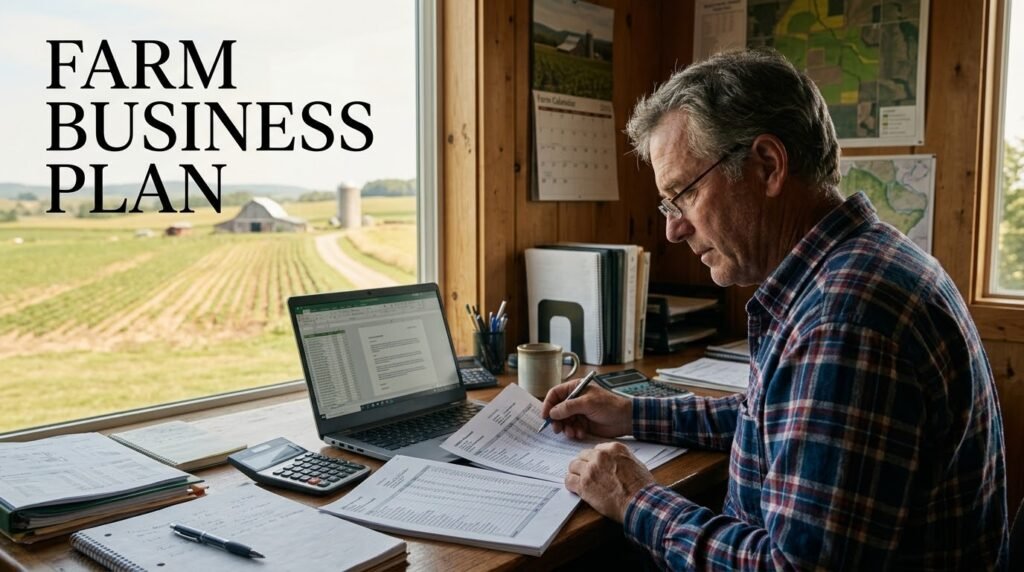
A farm can produce healthy crops or raise productive livestock and still struggle financially if costs, sales and daily operations are not planned carefully. A practical farm business plan helps you decide what to produce, who will buy it, how much money you need, and how you will measure whether the business is working. It does not need to be complicated or full of impressive language. It needs realistic assumptions, clear records and a plan you can update as conditions change.
Build the Business Side of Your Farm
If you plan to sell farm products online, develop a farming-related service or build an educational business around your agricultural experience, an online marketing platform may help you create a simple digital presence and communicate with potential customers.
Explore Online Business ToolsWhat Is a Farm Business Plan?
A farm business plan is a written guide explaining how your agricultural business will operate, serve its market and manage its finances. It connects your farming goals with the practical decisions required to achieve them.
Depending on the size and type of farm, the plan can cover:
- The farming activity and products you intend to sell.
- Your target customers and how you will reach them.
- Land, equipment, inputs, labour and other operating requirements.
- Production targets, seasonal schedules and sales forecasts.
- Startup funding, cash flow, expenses and financial risks.
- Record-keeping, performance measurements and future growth.
A small vegetable grower may need a concise plan with a budget and seasonal production calendar. A poultry operation, fish farm or commercial crop business may need more detailed production schedules, biosecurity procedures, working-capital estimates and sales agreements.
Step 1: Choose Your Farming Activity
Before estimating costs, define what your farm will actually do. “Starting an agricultural business” is too broad to budget properly. You need a clear first activity and a manageable scope.
Examples include:
- Crop production: vegetables, maize, cassava, rice, grains, fruits or other crops suited to your location and market.
- Livestock: poultry, goats, sheep, cattle or other animals where suitable facilities, feed, veterinary support and buyers are available.
- Aquaculture: fish production with attention to water quality, feed, stocking density and a dependable market.
- Nursery and seedlings: raising plants for farmers, landscapers or home growers.
- Value-added products: processing, packaging or preparing agricultural products where food-safety requirements, equipment and market demand are understood.
- Agricultural services: equipment hire, advisory services, produce aggregation or other services based on proven customer demand.
Choose based on more than popularity. Consider your experience, land and water access, local conditions, production cycle, available labour, capital and potential customers.
Questions to answer before committing
- What exactly will I produce or provide?
- Who is likely to buy it, and why would they choose my business?
- What technical skills or support will I need?
- What could prevent production or sales from going as planned?
- Can I begin on a smaller scale to test my assumptions?
Step 2: Research Your Market Before You Invest
Production does not automatically create a profitable business. You need a realistic route to market before spending heavily on land preparation, buildings, animals, equipment or inputs.
Start by identifying your likely buyers. Depending on the product, these may include households, retailers, market traders, restaurants, processors, wholesalers or institutional customers.
Investigate demand and competition
- Talk to potential buyers: Ask about the products, quantities, quality standards and delivery arrangements they require.
- Observe local markets: Record selling prices over time rather than relying on a single day’s price.
- Check competitors: Understand how established sellers compete on quality, consistency, location, convenience and price.
- Investigate seasonality: Demand and prices may change with harvest periods, weather, holidays, school calendars and supply conditions.
- Confirm logistics: Estimate transport, storage, packaging, spoilage and handling costs where relevant.
In Nigeria, for example, a farmer should consider local demand, transport routes, seasonal supply, input availability and the costs of moving produce from the farm to buyers. These conditions differ across states and products. Farmers in other countries should apply the same method using their own local market conditions.
Step 3: Calculate Your Startup Costs
Startup costs are the expenses required to establish the operation before it can run as intended. Separate one-time setup costs from recurring costs so you do not underestimate the money required.
| Cost category | What to include | Questions to ask |
|---|---|---|
| Land and site preparation | Lease or purchase costs, clearing, soil preparation, drainage and fencing where needed. | Is the land suitable, accessible and available for the intended use? |
| Water and utilities | Water access, irrigation, storage, pumping, electricity or other energy requirements. | Will water and power be reliable throughout the production cycle? |
| Buildings and equipment | Housing, storage, tools, machinery, protective equipment and repairs. | What must be bought now, and what can be hired or shared? |
| Initial inputs | Seeds, seedlings, feed, animals, fertiliser, soil amendments or other production inputs. | How much is needed for the first cycle, including likely wastage? |
| Labour and training | Setup labour, wages, technical support and essential training. | Which skills are missing, and who will perform each task? |
| Market preparation | Packaging, initial transport, handling, storage and customer acquisition. | How will products reach buyers in saleable condition? |
| Working capital | Cash reserved for routine expenses before sales receipts arrive. | Can the farm cover its bills if sales are delayed? |
Obtain current quotations from local suppliers and record the date of each quotation. Do not use an old online price as if it were a current local price. Where costs are uncertain, record a reasonable range and investigate the largest uncertainties first.
Step 4: Estimate Recurring Operating Expenses
Operating expenses are the costs of keeping the farm running. Depending on the enterprise, they can include feed, seeds, fertiliser, crop protection, labour, water, energy, transport, veterinary care, repairs, packaging, storage and marketing.
Prepare a cost estimate for each production cycle as well as a monthly cash-flow view. Some farms have substantial expenses long before the first sale, while others sell more frequently but face changing input and market prices.
Separate fixed and variable costs
- Fixed or relatively fixed costs: expenses that remain broadly similar over a period, such as certain rent, insurance, licence or salaried labour commitments.
- Variable costs: expenses that change with production, such as feed, seedlings, packaging, harvesting labour or transport volumes.
The classification depends on the business and time period. For example, hired labour may be fixed during one season but variable over a longer period.
Also distinguish cash expenses from non-cash costs. Equipment depreciation may affect profitability even when it does not require a payment in the current month. If you borrow money, account for repayment obligations and financing costs separately, using the terms of the actual loan.
Step 5: Set Realistic Production and Sales Targets
Estimate what the farm can reasonably produce, how much of that output can be sold and when customers are likely to pay. Use production records, local technical advice, trial results or reliable evidence from comparable operations where available.
Do not assume every seed will produce a marketable crop, every animal will reach its target, or every item produced will be sold at the planned price. Allow for losses, quality issues, spoilage, mortality where relevant and unsold inventory.
Build a simple revenue forecast
For a product sold by unit, kilogram, crate or another measurable quantity, a starting estimate is:
Expected quantity sold × expected selling price per unit.
For example, if a farmer expects to sell a certain number of crates, the forecast should use the number likely to be sold—not simply the number harvested. Use a realistic selling price based on market research, and state the assumptions behind the estimate.
For crops or livestock with different grades, sizes or product types, estimate revenue separately for each. This makes it easier to see which products contribute most to the business and which may require a different sales strategy.
Step 6: Prepare a Farm Cash-Flow Plan
A farm may appear profitable on paper but run out of cash because expenses occur before buyers pay. Cash-flow planning helps you anticipate these gaps and decide how much working capital is needed.
Map the expected timing of major cash movements:
- When inputs, wages, rent and utilities must be paid.
- When planting, stocking, maintenance or harvesting expenses occur.
- When the first products are expected to be ready for sale.
- When buyers are expected to pay, including any agreed credit period.
- When debt repayments, equipment costs or seasonal expenses fall due.
For seasonal farms, a month-by-month forecast may be useful even if revenue arrives only a few times a year. For farms with frequent sales, weekly or monthly tracking may be more practical.
Use three planning scenarios
| Scenario | Planning assumption | What to learn |
|---|---|---|
| Conservative | Lower sales, higher input costs or production delays. | Can the farm cover essential costs under pressure? |
| Expected | The most reasonable forecast based on the evidence available. | What resources and working capital will the plan require? |
| Favourable | Better yields, sales or costs than the expected case. | How could additional cash be reinvested responsibly? |
These are planning scenarios, not predictions. A good plan also states what action you would take if actual results fall below expectations.
Step 7: Decide How You Will Measure Profitability
Revenue is not the same as profit, and profit is not the same as cash available to spend. Track each separately so you can make sound decisions.
- Revenue: the value of products or services sold.
- Operating profit: revenue minus the relevant operating expenses, using a consistent accounting method.
- Cash flow: money entering and leaving the business over a period.
- Break-even point: the sales level at which the revenue from sales covers the costs included in the calculation.
For a simple business with one main product, a basic contribution calculation can help with break-even planning:
Selling price per unit − variable cost per unit.
Approximate break-even quantity
Fixed costs ÷ contribution per unit, provided the contribution is positive and the assumptions fit the business.
This simplified method is not suitable for every farm without adjustment. Multiple products, changing yields, spoilage, seasonal production and shared costs can make the calculation more complex. For a major investment, consider getting help from a qualified accountant or agricultural business adviser.
Step 8: Identify Risks and Plan Your Response
Farming is affected by biological, environmental, operational and market risks. A useful business plan identifies the risks that could most seriously affect the operation and specifies how you will monitor and manage them.
| Potential risk | Planning response |
|---|---|
| Weather or water shortages | Assess local conditions, water access, drainage and appropriate production methods before investing. |
| Pests, disease or animal health problems | Plan prevention, monitoring, hygiene and access to qualified technical support. |
| Input-price increases | Compare suppliers, keep quotations and test how higher costs affect the budget. |
| Falling market prices | Research different buyers, track seasonal prices and avoid relying on one unconfirmed sales price. |
| Transport or storage problems | Plan delivery routes, handling, storage requirements and backup arrangements. |
| Delayed customer payments | Set clear payment terms and keep enough working capital for essential expenses. |
| Equipment failure | Schedule maintenance and assess repair options or access to replacement equipment. |
Where available and appropriate, investigate relevant insurance, technical support and local agricultural services. Check the coverage, exclusions, costs and eligibility conditions instead of assuming protection is automatic.
Step 9: Keep Accurate Farm Records
Good records turn a business plan from a document into a management tool. They help you compare estimates with actual results, identify avoidable expenses, monitor production and understand which activities deserve more attention.
Start with records that answer specific questions:
- Financial records: sales, expenses, receipts, debts, payments due and cash balances.
- Production records: planting or stocking dates, inputs used, quantities produced and losses.
- Inventory records: seeds, feed, fertiliser, packaging, harvested products and other supplies.
- Customer and supplier records: orders, agreed prices, delivery dates, payment terms and outstanding balances.
- Labour and equipment records: work completed, maintenance, downtime and operating costs.
A notebook or spreadsheet may be enough for a small operation. As the farm grows, digital record-keeping can make it easier to organise transactions, review performance and share information with authorised team members. Choose a system you can maintain consistently, with appropriate backups and access controls.
Step 10: Choose Digital Tools That Solve Real Problems
Digital tools can help farmers organise the business side of an operation, but no single platform automatically solves every farm-management problem. Choose software based on the task you need to improve.
| Business need | Tool type to consider | What to check |
|---|---|---|
| Income and expenses | Spreadsheet or accounting software | Can you record transactions and produce useful reports? |
| Stock and supplies | Inventory tracking tools | Can you monitor quantities, usage and replenishment? |
| Production planning | Farm-management or production-record software | Does it support your particular crop, livestock or aquaculture activity? |
| Sales and customers | Order tracking, customer management or e-commerce tools | Can you track orders, delivery and outstanding payments? |
| Online promotion | Website, email marketing or online business platforms | Does it help you reach customers and support the sales process you need? |
Before paying for software, confirm the price, recurring fees, device compatibility, offline access if needed, export options and support availability. If connectivity is unreliable where you farm, check whether you can still enter records and synchronise them later.
For farmers who also sell products online, provide agricultural services or create farming-related educational content, an online business platform may complement farm records by supporting customer communication and marketing. It should not replace specialist production, livestock-health or accounting systems when those are needed.
Step 11: Set Milestones and Review the Plan
A business plan should guide actions, not remain untouched in a folder. Break the first phase of the business into milestones with a responsible person, target date, expected cost and measurable result.
For example, your first milestones might include:
- Confirm the production activity and suitable site.
- Interview potential buyers and validate the market assumptions.
- Collect supplier quotations and complete the startup budget.
- Prepare the production schedule and cash-flow forecast.
- Arrange essential equipment, inputs, training and records.
- Begin at a manageable scale and record actual costs and output.
- Review results after the first production or sales cycle before expanding.
Review the plan whenever major assumptions change. If feed prices rise, rainfall changes, a buyer cancels an order or actual output differs significantly from the forecast, update the relevant figures and decide what needs to change.
A Practical Farm Business Plan Checklist
Before investing significant money, use this checklist to identify gaps in your plan.
- I have defined the product or service my farm will offer.
- I have researched potential customers and competing suppliers.
- I have checked the suitability, access and permitted use of the site.
- I have estimated startup costs using recent, relevant quotations.
- I have calculated recurring costs and working-capital needs.
- I have prepared realistic production and sales forecasts.
- I have estimated cash flow and considered delayed sales or payments.
- I have identified major risks and planned responses.
- I have chosen a practical method for tracking income, expenses and production.
- I have defined milestones and conditions for reviewing or expanding the business.
Frequently Asked Questions
How do I write a farm business plan for a small farm?
Start with a clear description of your farming activity, target buyers, production requirements, startup costs, operating budget, sales forecast and main risks. Add a cash-flow plan and a simple record-keeping system. A small farm can begin with a concise document and expand it as the business grows.
Can I start a farming business with limited capital?
Some farming activities can be tested at a smaller scale, but the resources required vary widely. Assess land access, water, inputs, labour, equipment, production timing and customer demand before committing funds. Starting small reduces the size of an initial commitment but does not guarantee a profit.
What should a farm business plan include in Nigeria?
A plan for Nigeria should include the same core business and financial sections, adapted to the specific state, location and farming activity. Pay particular attention to local demand, input prices, water and land access, transport, power, seasonal conditions, relevant permits and the timing of cash receipts. Verify current local requirements and costs before investing.
Do I need a farm business plan to apply for a loan?
A lender may ask for a business plan, financial forecasts, quotations, ownership or tenancy documents, records and other supporting information. Requirements vary by lender and programme. Confirm the current eligibility criteria and documentation directly before relying on any financing option.
What software is best for farm business planning?
The best option depends on your operation. A spreadsheet may be sufficient for a small farm’s budget and records, while a larger operation may need accounting, inventory, production or specialist farm-management software. Compare features, costs, usability and data export options before choosing.
How often should I update my farm business plan?
Review it regularly—at least at meaningful production or financial milestones—and whenever major costs, production conditions, customer demand or business goals change. Compare actual performance with the original assumptions so the next version reflects what you have learned.
Final Thoughts: Plan Before You Scale
A practical farm business plan helps you connect production decisions with customers, costs, cash flow and the risks that can affect results. It gives you a clearer way to decide what to start, how much to commit and what evidence you need before expanding.
Begin with the information you can verify. Research your market, prepare realistic budgets, maintain accurate records and review results as you go. Whether you are planning a small farm in Nigeria or a larger agricultural operation elsewhere, a plan that reflects real conditions is more useful than one built on optimistic assumptions alone.
Affiliate disclosure: This article contains an affiliate link. If you sign up through the link and the referral qualifies under the provider’s terms, Digital Software Guide may earn a commission at no additional cost to you. We aim to recommend tools according to their relevance to the business task described, and readers should review the provider’s current features, pricing and terms before signing up.