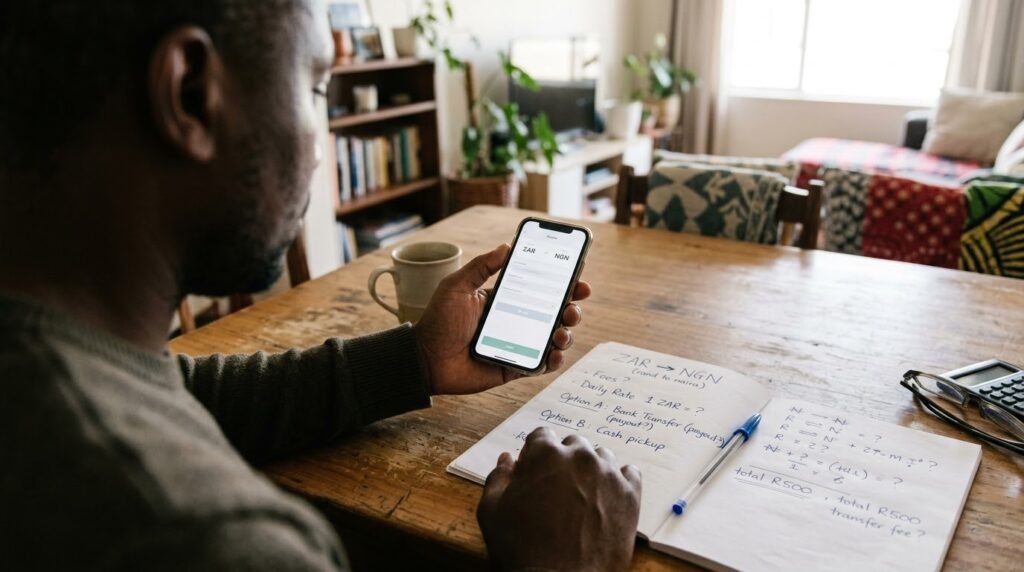
Sending money from South Africa to Nigeria can help families manage household expenses, support relatives, pay eligible expenses or meet other legitimate financial needs. But choosing a transfer service involves more than looking for a low advertised fee. You also need to understand the rand-to-naira exchange rate, payout options, transfer limits and the amount the recipient will actually receive.
This guide explains how to assess transfer options, compare costs fairly, prepare recipient details and reduce the risk of mistakes or scams. Because providers can change their services and pricing, always confirm the current terms for your own transfer before paying.
How Does Sending Money from South Africa to Nigeria Work?
An international remittance generally involves a sender in South Africa funding a transfer and a provider arranging payment to a beneficiary in Nigeria. Depending on the service, the recipient may be able to receive money into an eligible Nigerian bank account or collect cash through an approved payout network.
The available process depends on the provider, the sender’s eligibility, the funding method and the recipient’s details. A domestic South African bank transfer by itself is not necessarily an international remittance method. You need a service that specifically supports the South Africa-to-Nigeria route.
Before registering or depositing money, verify that the service currently accepts customers sending from South Africa and pays recipients in Nigeria. Also confirm that the transaction purpose and funding method are allowed under its terms.
Which Services Can You Check?
Several providers advertise services for this corridor. Grey, WorldRemit and LemFi are examples a sender may investigate. Their current eligibility rules, supported payment methods, fees and payout choices can differ, and availability can change.
Do not assume that a provider is suitable simply because it appears in a search result or because someone you know used it previously. Open the provider’s official service yourself and check the precise route and transaction details.
| Option to investigate | What to verify before sending |
|---|---|
| Grey | Current South African sender eligibility, account requirements, conversion charges, withdrawal fees and Nigerian payout availability. |
| WorldRemit | Whether the exact route is available, the supported funding method, the recipient’s payout choices and the final quoted amount. |
| LemFi | Current registration eligibility in South Africa, supported transfer purpose, funding options, fees and payout conditions. |
| Bank or other authorized provider | International payment capability, documentation, total charges, expected processing time and the institution’s regulatory status. |
These are starting points for independent comparison, not a ranking or guarantee that every service is available to every reader. Compare the actual quote displayed for your transfer before choosing.
Bank Deposit or Cash Pickup: Which Should You Choose?
The best payout method depends on how the recipient needs to access the money and which options the selected provider supports.
Bank deposit
A bank deposit may be convenient if the recipient has an eligible Nigerian account and wants the funds paid directly into it. Confirm the beneficiary’s account details, the name required by the provider and whether any receiving-bank conditions apply.
Cash pickup
Cash pickup can be useful when the recipient needs cash or does not have a suitable bank account. However, not every service offers cash collection for this corridor. Confirm the authorized pickup location, identification requirements, collection limits and any expiry or cancellation conditions before paying.
How to decide
- Choose a payout method the recipient can reliably access.
- Confirm the recipient’s details before authorizing the transfer.
- Compare the final amount for each available payout method.
- Check whether the recipient will pay any charges or need specific identification.
- Never assume that a service’s payout options are the same in every country.
Understanding Rand-to-Naira Exchange Rates
The exchange rate determines how much Nigerian naira is calculated from the rand amount being converted. However, the rate displayed by a transfer provider may differ from a market reference rate. Providers may also charge a separate transfer fee or other applicable charges.
A service advertising a zero transfer fee may still have a cost built into its exchange rate. Another service might display a fee but offer a different rate. You cannot identify the cheaper option by looking at either number alone.
Compare these details for the same sending amount:
- Total rand paid: The amount that will leave your account or payment method.
- Exchange rate: The rand-to-naira rate actually offered for your transaction.
- Transfer fee: Any separately disclosed service charge.
- Other charges: Any applicable funding, payout or intermediary costs.
- Final naira amount: The amount the recipient is expected to receive.
Example: Comparing Two Transfer Quotes
The following figures are hypothetical and are provided only to explain the comparison method. They are not current exchange rates, live provider quotes or advertised fees.
| Illustrative detail | Offer A | Offer B |
|---|---|---|
| Total amount paid | R2,000 | R2,000 |
| Example rate | ₦90 per rand | ₦91 per rand |
| Amount before fee | ₦180,000 | ₦182,000 |
| Illustrative fee deducted from payout | ₦1,000 | ₦3,000 |
| Approximate amount received | ₦179,000 | ₦179,000 |
In this example, the higher exchange rate in Offer B is offset by its larger illustrative fee, so both offers produce the same final payout. If the fee were charged separately rather than deducted from the payout, the comparison would need to account for the total rand cost instead.
For a real transfer, use the provider’s final quote and confirm how each fee is collected. If the quote shows the exact amount the recipient will receive, use that amount when comparing eligible offers.
How to Send Money from South Africa to Nigeria
- Confirm the reason for the payment. Determine whether it is family support, a personal payment, an eligible business transaction or another legitimate purpose. Use a payment channel that permits that purpose.
- Check the provider’s eligibility rules. Confirm that you can register and send from South Africa, and that the provider supports payment to your intended Nigerian payout method.
- Complete the required verification. Provide only the genuine information and documentation requested through the official service.
- Confirm the beneficiary details. Check the recipient’s full name, bank account details or cash-pickup requirements directly with the recipient.
- Enter the sending amount. Review the rand amount, conversion rate, fees and expected naira payout displayed for that specific transaction.
- Review the delivery estimate. Understand whether the estimate is conditional on successful funding, verification, processing hours or additional checks.
- Authorize the payment only after reviewing everything. Keep the receipt and transaction reference for follow-up.
- Confirm receipt safely. Ask the recipient to check their bank account or complete the official pickup process. If the money does not arrive as expected, contact the provider through its official support channel.
What Information Might You Need?
Requirements differ by provider, transaction amount and payout method. You may be asked for:
- Your legal name and contact information.
- Identity verification documents and proof of eligibility.
- A supported South African payment or funding method.
- The recipient’s full name and relevant Nigerian bank account details.
- The payment purpose and supporting documents, if required.
- Additional information if the provider needs to review the transaction.
Do not guess missing account details. Ask the recipient to confirm them directly. Never send your password, one-time passcode, card PIN or account recovery credentials to someone claiming to be a transfer agent.
How Long Does a Transfer Take?
Delivery times depend on the service, funding method, payout type, transaction checks and processing hours. Some eligible transfers may be processed quickly, while others may take longer or require additional review.
A time estimate shown before payment is not an unconditional guarantee. Check whether it describes the time to process the transfer, dispatch the funds or make them available to the recipient. Weekends, public holidays, incomplete verification or incorrect beneficiary details may affect the process.
Common Mistakes to Avoid
- Choosing only by the advertised fee: The exchange rate can materially change the final payout.
- Using a service without checking the exact route: International services do not all support the same sending and receiving countries.
- Entering incorrect recipient details: Errors may delay payment or cause a rejection.
- Ignoring transaction limits: A service may restrict transfer amounts or require extra verification.
- Assuming an estimated arrival time is guaranteed: Additional checks or bank processing can delay a payment.
- Sending a second payment too quickly: First confirm what happened to the original transfer.
- Using an unverified agent: Fake customer support and impersonation scams can lead to unrecoverable losses.
How to Protect Yourself from Remittance Scams
Fraudsters may impersonate transfer companies, advertise unrealistic exchange rates or pressure people into paying supposed release charges. Take a few precautions before funding a transfer.
- Access the provider through its verified official app or website.
- Check the provider’s legal identity and relevant regulatory authorization.
- Read the fees, exchange-rate terms, refund conditions and complaint process.
- Verify unexpected changes to bank details through a separate trusted channel.
- Never pay an unknown individual to unlock or release a transfer.
- Do not share one-time passcodes, passwords or card PINs.
- Keep receipts, transaction references and official support correspondence.
What to Do If Your Transfer Is Delayed
- Check the transaction status in the official app or account.
- Review the stated delivery window and any verification requests.
- Confirm the beneficiary details and ask the recipient to check the correct account or pickup instructions.
- Contact the provider’s official support team with the transaction reference.
- Ask whether the transfer is pending, rejected, returned or under review, and whether any charges will be refunded.
- Keep a record of the response and any complaint reference.
Do not repeat the payment until you understand the status of the first transaction. If the provider cannot resolve the issue, use its documented complaints process and the appropriate consumer or financial regulator for the relevant jurisdiction.
Pre-Transfer Checklist
- ☐ The provider currently supports sending from South Africa to Nigeria.
- ☐ I meet its identity, location and account requirements.
- ☐ My payment purpose is permitted.
- ☐ I have verified the recipient’s details.
- ☐ I know the total amount I will pay in rand.
- ☐ I have compared the exchange rate, all disclosed charges and final naira payout.
- ☐ I understand the payout method and estimated delivery time.
- ☐ I know how to track the transfer and contact official support.
Frequently Asked Questions
Can I send money from South Africa to a Nigerian bank account?
Some providers advertise transfers to Nigerian bank accounts from South Africa. Confirm that the route is currently available to you, check the required beneficiary information and review the final naira amount before authorizing payment.
Which service is the cheapest?
There is no single provider that is always cheapest for every amount and customer. Compare real quotes for the same rand amount at approximately the same time, including exchange-rate differences and all applicable charges.
Can the recipient collect cash instead of receiving a bank deposit?
That depends on the provider and the available payout options for the transaction. Check eligible pickup locations, identification requirements, limits and any applicable fees before sending.
Will the recipient receive the money instantly?
Not necessarily. Delivery depends on the service, funding, verification, payout method and processing conditions. Use the estimate shown for your actual transaction rather than assuming that all transfers are instant.
Is a zero-fee transfer always cheaper?
No. A provider may earn through its exchange rate or apply other disclosed charges. Compare the total cost and the final amount the recipient receives, not just the advertised transfer fee.
What if I entered the wrong recipient details?
Contact the provider immediately through its official support channel. Ask whether the payment can be stopped or corrected. Recovery depends on the transaction status and the provider’s terms, so do not assume the funds can automatically be recalled.
Final Thoughts
Sending money from South Africa to Nigeria is easier to plan when you confirm the route, verify the recipient and compare the full cost before paying. A provider’s advertised fee or exchange rate alone cannot tell you whether it is the best option for your transfer.
Check eligibility, calculate the final naira payout, understand the delivery estimate and keep your transaction record. Most importantly, use a legitimate service and never let pressure or an unusually attractive offer replace careful verification.
Financial information notice: This article is for general educational purposes and does not guarantee the availability, price, delivery time or suitability of any provider. Services, exchange rates, fees and regulatory requirements can change. Confirm current terms with the relevant institution before sending money.