How to Choose Digital Money Transfer Services for International Payments
Sending money to another country should not require guesswork. Whether you are supporting family, paying an overseas supplier, receiving freelance income, or managing international expenses, the transfer service you choose can affect how much money arrives, how quickly it gets there, and how confidently you can complete the transaction.
Digital money transfer services make cross-border payments possible through websites, mobile applications, bank accounts, mobile wallets, and other supported payment methods. However, services differ in their fees, exchange rates, transfer limits, delivery options, and eligibility requirements.
The best choice is not necessarily the service advertising the lowest fee or fastest delivery. It is the option that meets your needs, provides a competitive total cost, supports your countries and payment methods, and explains its terms clearly.
1. Understand the Different Types of Money Transfer Services
Start by identifying the type of service that fits your transaction. Different providers may specialize in personal remittances, business payments, bank transfers, or digital wallet transactions.
Online money transfer platforms
These services let customers initiate transfers through a website or application. Depending on the provider and destination, the recipient may receive funds in a bank account, mobile wallet, or another supported payout channel.
Bank-to-bank international transfers
Banks may offer international transfers directly from an account. These can be useful for established banking relationships or certain business payments, but the overall cost may include sending fees, intermediary charges, receiving-bank fees, and exchange-rate differences.
Mobile wallet transfers
Some services support payments to a recipient’s mobile wallet. This may be convenient where the recipient regularly uses a supported wallet, but availability, limits, withdrawal options, and fees vary by country and provider.
Cash pickup services
Some providers allow recipients to collect funds at designated locations. This can be helpful when a recipient cannot use a bank account, although location coverage, identification requirements, opening hours, and collection limits should be checked first.
Business payment services
Businesses and freelancers may need to pay overseas suppliers, contractors, or service providers. Business-focused platforms may offer additional features such as payment records, multiple-user access, invoices, or accounting integrations. Confirm that the service supports your business type, countries, and intended transactions.
2. Compare the Total Transfer Cost
Transfer costs can come from more than one place. Reviewing the complete transaction helps you avoid choosing a service based only on its headline fee.
- Transfer fee: The amount charged to initiate or process the payment.
- Exchange-rate margin: The difference between the rate offered to you and a relevant market reference rate.
- Intermediary fees: Charges that may apply when funds pass through other financial institutions.
- Receiving fees: Fees that the recipient’s bank, wallet, or payout provider may charge.
- Funding fees: Additional costs that may apply depending on whether you pay by bank transfer, debit card, credit card, or another method.
Not every transfer includes all these charges. The exact costs depend on the provider, currency pair, payment method, destination, and transfer type.
Compare the final amount received
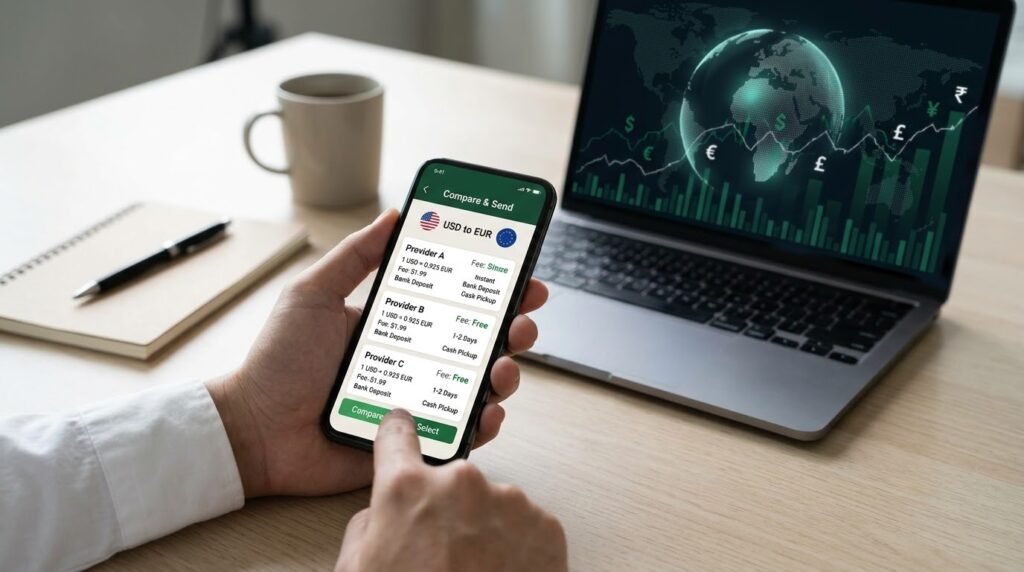
For a practical comparison, enter the same sending amount, source currency, destination currency, and recipient payout method into each service you are considering. Then compare the displayed recipient amount and check whether any additional charges may apply.
Also check whether the displayed quote is guaranteed for a specific period or can change before the transaction is completed.
3. Check the Exchange Rate Carefully
When money crosses currencies, the exchange rate can have a major effect on the final payout. A provider may advertise a low transfer fee while earning revenue through the exchange rate it offers.
Before confirming a payment:
- Check the exchange rate displayed for your exact currency pair.
- Compare quotes from other suitable providers at approximately the same time.
- Confirm the amount the recipient is expected to receive.
- Check whether the rate is fixed for the transaction or may change.
- Look for any conditions attached to promotional rates.
Exchange rates change over time. Comparisons made hours or days apart may not be directly equivalent, so use current quotes when deciding which service to use.
4. Evaluate Transfer Speed and Delivery Times
Some transfers may arrive within minutes, while others can take several business days. Speed depends on factors such as the countries involved, payment method, banking hours, compliance checks, weekends, public holidays, and the recipient’s institution.
Look for the provider’s estimated delivery time for your specific route. Distinguish between an estimate and a guarantee, and check whether the estimate begins when you submit the transaction or when the provider receives cleared funds.
If the payment is urgent, confirm the expected delivery window before paying. Do not assume that a service offering fast transfers for one country or payment method offers the same speed everywhere.
5. Confirm Supported Countries, Currencies, and Payout Methods
A service may be available in your country but may not support the destination or currency you need. Some providers also restrict the ways money can be funded or collected.
Before creating an account, verify the following:
- Your country is supported for sending money.
- The recipient’s country is supported for receiving money.
- The required sending and receiving currencies are available.
- The recipient can use the proposed bank, wallet, or cash pickup method.
- The transfer amount falls within the applicable minimum and maximum limits.
- The provider supports your intended personal or business purpose.
These checks are especially important for international transactions involving less commonly supported currency pairs or specific business payment needs.
6. Review Security, Regulation, and Verification Requirements
Money transfers involve financial information and funds, so security deserves as much attention as price and convenience.
Before using a provider, investigate its identity, operating status, and customer protections in the relevant jurisdiction.
- Regulatory status: Check the relevant official financial regulator’s records where applicable. Requirements vary between countries and service types.
- Website authenticity: Confirm that you are using the provider’s genuine website or official application.
- Account protection: Look for appropriate authentication and account-security controls.
- Privacy information: Read how the provider collects, uses, stores, and protects personal information.
- Verification requirements: Understand what identification and supporting documents may be requested.
- Complaint process: Check how to report suspicious activity, challenge a transaction, or make a formal complaint.
Never share your password, one-time security code, or account recovery details with someone claiming to be customer support. Be cautious of unsolicited messages promising unusually favorable exchange rates or demanding extra payments to release a transfer.
7. Understand Limits, Cancellations, and Refunds
Transfer services can impose limits based on the sending country, destination, verification level, payment method, or applicable law. A service may also request additional documents before releasing a payment.
Read the terms before confirming your transfer, paying particular attention to:
- Daily, monthly, and per-transaction limits.
- Possible additional identity checks.
- Whether a transfer can be cancelled after submission.
- Refund eligibility and expected processing time.
- What happens if recipient details are incorrect.
- How the provider handles delayed, rejected, or returned transfers.
Once a transfer has been completed or collected, recovery may be difficult or impossible. If you enter the wrong recipient information or suspect fraud, contact the provider immediately.
8. Choose a Service That Suits the Recipient
The recipient’s circumstances are just as important as the sender’s preferences. A transfer method that works well for one person may be inconvenient or unavailable for another.
Consider whether the recipient:
- Has an active bank account that can receive the funds.
- Uses a mobile wallet supported by the provider.
- Can access a cash pickup location if that method is offered.
- Needs the funds by a particular date.
- May face fees when receiving, withdrawing, or converting the money.
Check recipient details carefully before submitting a transfer. Names, account numbers, routing details, and other required information should match the instructions provided by the receiving institution.
9. Use This Comparison Table Before Deciding
Use the table below to compare the services you have shortlisted. Fill in the information using each provider’s current quote and published terms.
| What to compare | Questions to ask |
|---|---|
| Total cost | What fees and exchange-rate costs apply, and how much will the recipient receive? |
| Delivery time | When is the money expected to arrive, and what could delay it? |
| Supported route | Are both countries and the required currencies supported? |
| Payout method | Can the recipient receive the money conveniently? |
| Security and regulation | Can the provider’s identity and relevant regulatory status be verified? |
| Transfer limits | Can the provider handle the amount you need to send? |
| Customer support | Is there a clear process for delays, complaints, and disputed transfers? |
| Cancellation and refunds | What happens if the transaction fails or the recipient details are wrong? |
A simple comparison like this can make it easier to identify the strongest option for your specific transfer instead of relying on advertisements or a single feature.
10. Common Money Transfer Mistakes to Avoid
Choosing by transfer fee alone
A low visible fee may be offset by an unfavorable exchange rate or other charges. Compare the final recipient amount.
Ignoring the recipient’s needs
A transfer is not useful if the recipient cannot access the payout method or faces unexpected withdrawal charges.
Assuming every transfer is instant
Processing times can vary by route, payment method, compliance checks, and banking hours. Review the estimate for the actual transaction.
Failing to verify the provider
Do not rely solely on online advertisements, social media recommendations, or testimonials. Check the provider’s identity and relevant regulatory status independently.
Sending money before checking the details
Review the recipient information, currency, transfer amount, fees, and expected payout before confirming. Save the receipt and transaction reference.
Sending money to someone you do not trust
Be careful with requests involving urgent emergencies, guaranteed investments, suspicious job offers, romance-related financial requests, or pressure to send money immediately. Verify the situation through an independent channel.
11. A Practical Checklist Before You Send Money
Complete these checks before confirming an international transfer:
- Confirm that the provider supports both countries and currencies.
- Compare the total cost and final recipient amount.
- Check the estimated delivery time.
- Verify the recipient’s details and payout method.
- Review the provider’s legitimacy, security, and relevant regulatory status.
- Understand transfer limits, cancellation rules, and refund conditions.
- Check for possible receiving or withdrawal fees.
- Save the transaction receipt and reference number.
Frequently Asked Questions
What is the cheapest way to send money internationally?
The cheapest option depends on the countries, currencies, amount, payment method, and payout method. Compare current quotes and the amount the recipient will receive rather than judging by the advertised transfer fee alone.
Are digital money transfer services safe?
Safety varies by provider and transaction. Verify the service’s identity and applicable regulatory status, use its official website or application, protect your login details, and confirm the recipient before sending funds.
How long do international transfers take?
Some transfers arrive within minutes, while others take several business days. The timing depends on the provider, destination, payment method, receiving institution, and any required checks.
Why is the exchange rate different from the rate I see online?
Providers may use their own exchange rates and include a margin in the conversion. Market reference rates can also change. Compare the provider’s actual quote and final payout at the time you intend to transfer.
Can I cancel an international money transfer?
Sometimes, depending on the provider and transaction status. Cancellation may no longer be possible after the funds have been paid out or collected. Review the provider’s terms and contact it promptly if you need help.
What information do I need to send money abroad?
Requirements vary by country, provider, and payout method. You may need identity verification, recipient details, payment information, and in some cases the purpose of the transfer or supporting documents.
Final Thoughts
Choosing an international money transfer service is about more than finding the lowest advertised fee. The right decision balances the total cost, exchange rate, delivery speed, security, supported payout methods, and quality of customer support.
Compare services using the same transfer amount and currency pair, read the relevant terms, verify the provider independently, and confirm the recipient details before sending funds. A few minutes of careful checking can help you make a more informed decision and avoid preventable problems.
Editorial note: This article is for general educational purposes only. It does not constitute financial, legal, tax, or investment advice. Service availability, fees, exchange rates, regulations, and consumer protections vary by jurisdiction and can change. Verify current information directly with the provider and relevant official authorities before making a transaction.