Farming Business • Agricultural Finance
Farmers Loan Portal: How to Find Agricultural Financing and Apply Safely in Nigeria
When a farm needs seed, fertiliser, feed, irrigation equipment, labour or working capital, suitable financing may help keep production moving. The challenge is finding a legitimate funding route, understanding the real repayment obligation and knowing whether an advertised application portal is genuine.
Searching for a farmers loan portal in Nigeria can produce government announcements, bank products, agricultural credit schemes, cooperative offers and social media advertisements. These options are not interchangeable. Some facilities are intended for established agricultural businesses, some require farmers to work through a group or anchor organisation, and some opportunities may no longer be accepting applications.
This guide explains how to assess a loan opportunity, prepare a credible application, compare borrowing costs and identify warning signs before handing over money or sensitive documents. It is an educational guide, not a loan offer or a promise of approval.
Before you apply
Confirm the organisation responsible for the programme, whether applications are currently open and which institution will actually receive and assess your application. A page using words such as “government approved,” “farmer support” or “loan portal” is not proof of authenticity.
Organising Your Farm Business Online?
Once your farm has a clear offer and budget, a website or landing page can help explain your products, collect customer enquiries and organise follow-up. Systeme.io provides online business tools for these tasks. It is not a lender, does not provide agricultural loans and cannot guarantee financing or sales.
Explore Farm Business Website Tools →Affiliate link: Digital Software Guide may earn a commission if you sign up through this link, at no additional cost to you.
1. What Is a Farmers Loan Portal?
A farmers loan portal is an online platform or application page used to provide information about agricultural financing or collect details from prospective borrowers. Depending on the provider, it may be operated by a financial institution, government agency, agricultural programme or authorised partner.
The word “portal” describes how information or applications are handled. It does not tell you whether the money is a grant, a repayable loan, subsidised credit or a commercial lending product.
| Financing route | What it generally means | What to confirm |
|---|---|---|
| Agricultural bank loan | A repayable facility assessed by a lending institution. | Interest, fees, collateral, repayment dates and eligibility. |
| Government-supported credit | A credit arrangement that may involve participating financial institutions. | Current scheme status and authorised application route. |
| Anchor-linked financing | Farmers may be organised through an association, processor or other anchor. | Input arrangements, buyer obligations and repayment responsibilities. |
| Private agricultural lender | A private institution offers credit under its own terms. | Provider identity, total cost, security requirements and complaint process. |
| Grant or input-support programme | Support may be non-repayable or subject to special conditions. | Whether it is genuinely a grant, what conditions apply and whether applications are open. |
Never assume government involvement means free money. Some programmes provide repayable financing, require applications through an institution or impose conditions on how funds and inputs must be used.
2. How to Find a Suitable Farmers Loan Portal in Nigeria
Step 1: Identify the organisation responsible
Write down the full programme name and the institution responsible for it. Look for an explanation of its purpose, eligibility criteria, application procedure, contact channels and repayment terms.
If a message claims that a bank or government agency is running a scheme, independently confirm the claim through that institution’s established contact channels. Do not rely only on the phone number, social media account or link supplied by the promoter.
Step 2: Confirm that applications are open
Old announcements and copied registration pages can remain online after an application window closes. Check the announcement date, closing date, extension notices and latest official update.
If there is no clear confirmation that applications are open, treat the opportunity as unverified. Ask the responsible institution whether it is accepting applications and whether the advertised process is still valid.
Step 3: Match the scheme to your farm
Check whether the facility accepts your agricultural activity, location, business structure, farm size, intended use of funds and operating history. A scheme that supports agriculture generally may still exclude a particular applicant or purpose.
Confirm whether individual farmers can apply directly or must apply through a cooperative, commodity association, anchor organisation or participating financial institution.
Step 4: Obtain the complete terms in writing
Before accepting an offer, request the amount offered, interest calculation method, all fees, repayment dates, collateral requirements, grace-period conditions and consequences of late payment. Ask how much money will actually be disbursed after deductions.
Words such as “low interest,” “easy approval” and “no stress” do not reveal the total cost of borrowing.
3. Agricultural Financing Routes Worth Investigating
Nigeria has had agricultural financing arrangements involving commercial banks, agricultural finance institutions and government-supported credit structures. The examples below help explain possible routes. Their inclusion does not mean a scheme is currently open, that funds are available or that you qualify.
Agricultural Credit Guarantee Scheme Fund (ACGSF)
The Agricultural Credit Guarantee Scheme Fund is a credit-guarantee arrangement associated with agricultural lending through participating financial institutions. A guarantee supports lending; it is not a grant paid directly to every farmer and does not remove the borrower’s repayment obligation.
If a facility is described as ACGSF-supported, ask the proposed lender how the arrangement applies to your application, what security is required, which agricultural activities qualify and which documents must be submitted.
Commercial Agriculture Credit Scheme (CACS)
The Commercial Agriculture Credit Scheme has been described as a financing route for commercial agricultural enterprises. Published arrangements have included applications through participating deposit money banks, with conditions relating to business structure and acceptable collateral.
Do not assume that an individual smallholder can apply under the same terms as a registered agricultural company. Confirm the current status, applicant category, eligible project size and application route with the institution handling the facility.
Anchor-linked agricultural financing
Some financing models connect farmers with a larger organisation, such as a processor, commodity association or other anchor. Under the documented Anchor Borrowers’ Programme model, participating farmers have been organised through an anchor linked to a participating financial institution.
This type of arrangement may suit farmers producing a supported commodity who can meet the programme’s group, production and repayment requirements. Before joining, understand who supplies inputs, who buys the harvest, how output is assessed, what deductions may apply and who remains responsible for repayment if production falls short.
Bank of Agriculture and other agricultural finance providers
Farmers can also investigate products offered through established agricultural finance institutions, commercial banks and eligible microfinance banks. Availability and eligibility vary by product.
Be cautious with viral announcements claiming that a new national loan or mechanisation programme is accepting applications. Programme names can be copied by unrelated websites. Confirm the latest position with the named institution rather than treating a forwarded message as proof.
Check application status carefully
Programme names and old registration pages can remain visible after applications close. In February 2026, the Bank of Agriculture announced that applications for RHNAMP and related opportunities had closed and warned against unverified third-party application links. Confirm the present status directly with the responsible institution before submitting information or paying any requested charge.
4. Documents to Prepare Before Applying
Requirements differ by lender and programme. This checklist is for preparation, not a universal list of mandatory documents. Submit only what the verified institution requests through its confirmed process.
- Identity information: valid identification and any required verification details.
- Banking details: information required by the lender, shared only through a confirmed application channel.
- Farm details: location, land access or tenure information, production type and approximate operating scale.
- Production records: crop cycles, livestock numbers, input purchases, harvest quantities or relevant operational records.
- Sales evidence: receipts, invoices, buyer records or transaction history where available.
- Costed farm plan: an itemised explanation of how the requested funds will be used.
- Cash-flow forecast: when the farm expects to spend money, generate income and make repayments.
- Business or group records: registration, cooperative membership or association documents where required.
- Security documents: collateral or guarantor information only where the verified terms require it.
A farmer without formal accounts can begin with a notebook or spreadsheet recording purchases, labour, transport, sales and money received. Be accurate. Do not create false receipts, inflate production figures or claim ownership of land or equipment you do not own.
5. Build a Farm Budget That Explains the Loan Request
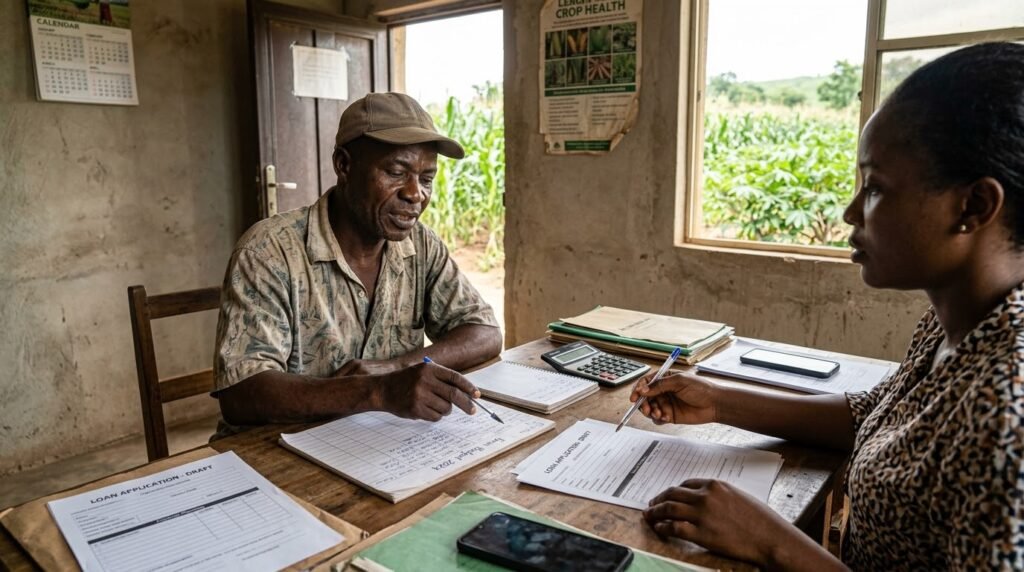
A lender needs to understand why you want the money and how the farm is expected to repay it. Instead of writing only “I need money for my farm,” prepare a costed plan that links each expense to a specific production activity.
A poultry farmer might itemise feed, chicks, vaccination, litter, labour, water and transport. A vegetable farmer might include seed, land preparation, irrigation, fertiliser, crop protection, harvesting crates and delivery. A fish farmer might calculate fingerlings, feed, water management, labour and harvest transport.
| Budget item | What to record | Why it matters |
|---|---|---|
| Production inputs | Quantity, unit price and total cost. | Shows how the requested amount was calculated. |
| Labour and operations | Tasks, workdays and payment estimates. | Prevents day-to-day costs from being overlooked. |
| Equipment | Purpose, quotation and expected useful life. | Helps match the financing duration to the investment. |
| Transport and storage | Input delivery, produce movement and storage costs. | Captures costs that reduce money available for repayment. |
| Contingency | A reasonable allowance based on identified risks. | Helps test the plan against modest cost increases. |
Separate one-time investment costs from recurring costs. A pump may serve several production cycles, while feed or fertiliser must be purchased repeatedly. Your repayment plan should reflect that difference.
6. Calculate Whether the Farm Can Repay the Loan
Do not decide the loan amount only by asking how much the lender is willing to offer. Estimate how much cash the farm can realistically generate after production and operating expenses.
The figures below are hypothetical and are not a current Nigerian loan offer or market rate.
Worked example: a farm working-capital loan
This simplified example assumes the ₦700,000 is available after operating costs and before the stated loan repayment. It excludes household withdrawals, other debts, taxes and any unexpected expenses not already included in the budget.
On paper, the farm has ₦125,000 remaining after repayment. That does not automatically make the loan safe. Test what happens if the harvest is smaller than expected, the selling price falls, a buyer delays payment or production costs rise.
Run a downside test
Recalculate the farm’s cash position using a less favourable outcome. Reduce expected sales revenue and increase one or two important costs. If the farm can no longer meet repayments, consider reducing the loan, changing the timing, finding a lower-cost option or postponing the investment.
Do not count the same expected sales twice. If produce has already been allocated to another debt repayment, it should not also be treated as fully available cash for a new loan.
Match repayment dates to farm cash flow
A crop farmer may receive most income after harvest, while an egg business may generate income more regularly. Equal monthly instalments may fit one enterprise better than another.
Ask whether the repayment structure matches your production cycle. If a grace period is offered, find out when it starts and ends, whether interest continues during it and when the first payment becomes due. A grace period is not necessarily a period without cost.
7. Compare Loan Offers Properly
When you have more than one verified offer, compare them on the same basis. A lower advertised interest rate does not always mean the lowest total cost.
| Comparison point | Question to ask |
|---|---|
| Net amount received | How much will actually enter the farm’s account after deductions? |
| Interest calculation | Is interest calculated on the original principal or outstanding balance? |
| All fees | Are there processing, insurance, account, legal or valuation charges? |
| Total repayment | What is the total amount payable over the entire facility? |
| Repayment frequency | Are payments monthly, seasonal, quarterly or based on another schedule? |
| Collateral and guarantees | What security is required, and what happens if repayment fails? |
| Early repayment and default | Are there early repayment charges, late fees or other consequences? |
Request a written repayment schedule before accepting. If the lender cannot explain the total amount due in clear terms, do not sign until you understand the obligation.
8. How to Recognise a Fake Farmers Loan Portal
Farmers seeking financing can be targeted by pages that imitate public institutions, use official-sounding programme names or advertise guaranteed approval. A professional-looking logo and a form collecting personal information do not prove that a portal is genuine.
Stop and verify if you notice these warning signs
- A stranger promises guaranteed approval before reviewing your farm or finances.
- You are pressured to pay a personal account or agent to “unlock” a government loan.
- An urgent deadline is used to prevent independent verification.
- The page or account cannot be independently connected to the named institution.
- The offer does not explain the lender, repayment terms, fees or complaints process.
- You are asked for your banking password, card PIN or one-time authentication code.
- The agent refuses to provide written terms or a verifiable institutional contact.
- The offer promises free money but introduces unexplained payments later.
Not every application fee is automatically fraudulent. The important step is to confirm the charge, its purpose and the official payment recipient directly with the responsible institution before paying.
Use this verification procedure
- Record the claim. Note the exact programme name, named organisation, closing date and promoter.
- Find an independent contact route. Use contact details obtained independently from the institution’s established channels.
- Ask whether applications are open. Request confirmation of the application window and authorised submission process.
- Confirm payment arrangements. Ask for the official basis of any charge and the approved recipient.
- Check document handling. Ask why each sensitive document is needed and how it will be submitted securely.
- Keep evidence. Save the announcement, written terms, receipts and relevant correspondence.
If you suspect a scam, stop sharing information, preserve evidence and contact your financial institution promptly if you have already sent money or exposed account credentials. Use the appropriate official reporting channel for your circumstances.
9. What If You Do Not Have Formal Farm Accounts?
A small farm does not need complicated accounting software to start improving its records. A notebook or spreadsheet can capture useful information if records are consistent and truthful.
For each production cycle, record the date, item purchased, quantity, amount paid, supplier, labour costs, harvest quantity, sale price, buyer and amount actually received. Keep expenses separate from sales and distinguish outstanding customer payments from cash already collected.
At the end of each week, total the expenses and sales. At the end of a production cycle, compare the original budget with actual spending and income. Explain major differences, such as lower yield, disease, price changes, damaged produce or unexpected transport costs.
These records help you estimate the next cycle more realistically and answer questions about your operations. They do not guarantee loan approval, but they are more useful than unsupported estimates prepared only to satisfy an application.
10. A Seven-Day Application Preparation Plan
| Day | Action | Expected result |
|---|---|---|
| Day 1 | Define the purpose and amount of funding required. | A specific financing target. |
| Day 2 | Prepare an itemised farm budget. | A clear spending breakdown. |
| Day 3 | Gather production, sales and expense records. | Evidence supporting financial estimates. |
| Day 4 | Identify suitable financing routes. | A shortlist based on farm activity and structure. |
| Day 5 | Verify programme status and the application channel. | Reduced risk of closed schemes and impersonation. |
| Day 6 | Compare repayment terms and test a downside scenario. | A clearer view of affordability and risk. |
| Day 7 | Review documents and submit through the verified route if suitable. | A more organised application record. |
This is a preparation schedule, not a promise that a lender will process or approve an application within seven days. Verification and lending decisions can take longer.
11. Farm Loan Readiness Worksheet
Complete this worksheet before approaching a lender. It helps identify missing information and discourages borrowing more than the farm can reasonably repay.
My farm financing plan
Farm or business name:
Location and agricultural activity:
Purpose of the loan:
Amount requested:
Itemised use of funds:
Expected date or period of farm income:
Cash available for repayment after operating costs:
Existing loans and repayment commitments:
Documents still required:
Institution and application channel verified:
Total repayment and due dates confirmed in writing:
Frequently Asked Questions
Is there one official farmers loan portal for all Nigerian farmers?
Do not assume there is one portal covering every agricultural loan. Different institutions and programmes may have separate eligibility rules and application procedures. Verify the organisation responsible for the specific offer.
Can an individual farmer apply without registering a company?
It depends on the facility. Some arrangements have conditions tied to business structure, while others may work through individual farmers, groups or associations. Confirm eligibility before preparing the application.
Can I get an agricultural loan without collateral?
Requirements vary by lender, programme, amount and risk assessment. Do not assume collateral is unnecessary because an advertisement says “easy loan.” Ask for the written security requirements and whether a guarantor or other condition applies.
Are government agricultural loans always interest-free?
No. Government involvement does not automatically make financing interest-free or non-repayable. Confirm whether the offer is a loan, grant, subsidised facility or another form of support, and read the complete terms.
Should I pay an agent who promises to secure approval?
Do not pay someone merely because they promise approval. Independently verify the person’s authority, the official application process and any permitted charges with the institution responsible for the facility.
What if I find an old farmers loan application page?
Do not assume it is still accepting applications. Confirm the current status and authorised application route directly with the responsible institution. An old page can remain visible after a programme closes.
How much should I borrow?
Base the amount on a costed farm plan and realistic repayment forecast, not only on the maximum amount offered. Test whether the farm could repay if production, prices or payment timing turn out worse than expected.
Final Checklist Before You Submit
- I know the exact purpose and amount of funding required.
- My budget is based on realistic quantities and costs.
- I have estimated when the farm will generate repayment cash.
- I understand interest, fees, total repayment and payment dates.
- I have independently confirmed the institution and current application status.
- I know what collateral, guarantees or group obligations may apply.
- I have not shared passwords, PINs or one-time authentication codes.
- I have kept copies of my application and written terms.
Finding a farmers loan portal is only the first step. A sound financing decision requires a verified application route, a credible farm budget, clear repayment terms and a realistic assessment of what the business can afford. Prepare the numbers before borrowing, confirm important claims independently and walk away from offers that cannot withstand basic checks.
Build a Stronger Online Presence for Your Farm Business
After organising your farm’s costs and plans, you may also want to present your products and business professionally online. Systeme.io offers tools for creating landing pages, websites and customer follow-up systems. These tools can support business organisation, but they are not a loan service and do not guarantee financing or customers.
See Tools for Growing Your Farm Business →Affiliate link: Digital Software Guide may earn a commission if you sign up through this link, at no additional cost to you.
Affiliate disclosure: This article contains an affiliate link to Systeme.io. If you sign up through the link, Digital Software Guide may earn a commission at no additional cost to you. Systeme.io is an online business software service, not a lender or agricultural loan provider. This article provides general educational information, not a loan offer or financial advice. Eligibility, funding availability, rates, fees and application procedures can change. Confirm current terms with the institution responsible for the specific facility before applying.