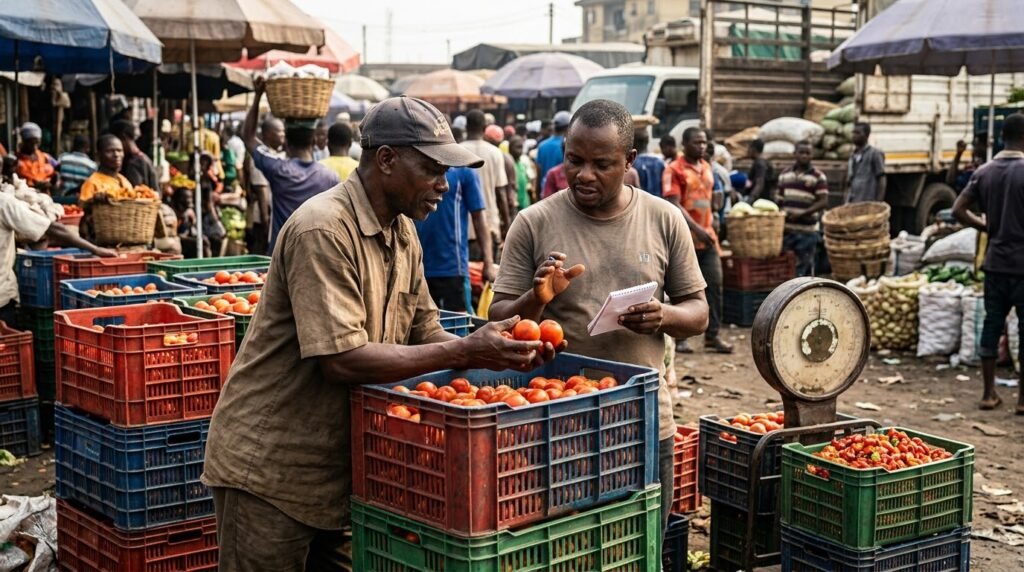
Farming Business • Lagos Agricultural Markets
Farmers Market in Lagos: How to Find Fresh Produce Markets and Sell Agricultural Products
Selling farm produce in Lagos can give farmers access to a large urban customer base, but a busy market does not automatically mean a profitable sale. The distance from the farm, the quantity buyers need, market charges, produce quality, transport arrangements and the price actually received can determine whether a market trip makes financial sense.
For farmers searching for a farmers market in Lagos, the practical question is not simply where food is sold. It is which selling channel suits the crop, available quantity, harvest timing and delivery budget. A vegetable farmer with several crates may need a different buyer from a commercial farmer delivering a truckload of produce.
This guide explains how to assess Lagos market options, prepare produce for delivery, calculate a break-even selling price, check buyers and record the real outcome of each trip. The goal is to help farmers make better selling decisions rather than travel to a market and hope for the best.
Building a More Organised Farm Business?
If you want to promote your produce, explain your products to potential customers or collect enquiries for your farm business, a simple online business page can help you present your offer professionally. Systeme.io provides tools for creating websites, landing pages and customer follow-up systems. It is a business software service, not a produce marketplace, and it does not guarantee buyers or sales.
Explore Farm Business Website Tools →Affiliate link: Digital Software Guide may earn a commission if you sign up through this link, at no additional cost to you.
1. Understand the Main Types of Produce Markets in Lagos
Lagos has several types of food-selling channels. They serve different purposes, and farmers should confirm current trading arrangements, access requirements, fees and buyer demand before transporting a harvest.
Wholesale produce markets
Wholesale markets bring together traders who buy and resell agricultural produce in larger quantities. They may suit farmers with a consistent harvest, bulk deliveries or products that can be sorted and packed efficiently.
Mile 12 International Market is a well-known Lagos food and produce trading hub associated with the distribution of fresh food. However, a farmer should not assume that every buyer there purchases every crop, accepts every quantity or offers the same price. Confirm the relevant commodity traders, delivery expectations and unloading arrangements before making the trip.
Wholesale trading can move produce in volume, but the price offered to a farmer may be lower per unit than a direct retail price. That difference is not necessarily a loss: wholesalers may take larger quantities and reduce the time and effort required to sell individual units.
Neighbourhood and urban food markets
Markets such as Oyingbo and Daleko are familiar parts of Lagos’s food-trading landscape. Their suitability depends on the product, the particular traders operating there and the buying arrangements available when you intend to sell.
Before choosing a market, establish whether your crop is commonly traded through the buyers you plan to approach. A name being well known is not enough to establish that it is the best destination for your particular harvest.
Retailers, restaurants and food businesses
Restaurants, caterers, food vendors, small grocery businesses and neighbourhood retailers may buy directly from farmers or through intermediaries. These buyers may value consistent quality, dependable delivery and predictable quantities.
Direct supply can reduce the number of intermediaries, but it also creates additional responsibilities. You may need to agree on delivery times, pack produce to the buyer’s specification, issue receipts and follow up on payments. Some businesses may also expect credit, which creates a cash-flow risk for the farmer.
Direct-to-consumer selling
Farmers with smaller quantities or products suited to household purchases may explore direct orders from consumers. This can involve pre-orders, scheduled collection or coordinated delivery.
However, the farmer must account for customer communication, packaging, delivery expenses, failed deliveries and the time spent handling small orders. A higher selling price per kilogram does not necessarily produce a higher profit per hour or per trip.
Market-selection rule
Choose the buyer and selling channel that provide the strongest realistic return after transport, handling, market charges, spoilage, rejected produce and time. Do not choose a destination based only on its reputation or an advertised price.
2. Match the Market to Your Crop and Quantity
Before setting out for Lagos, identify the characteristics that affect how your produce should be sold. Perishable crops often need faster handling than dry, storable products. A small harvest may be easier to sell directly, while larger volumes may justify negotiating with wholesalers or regular commercial buyers.
| Produce or farm product | Important selling considerations | Questions to settle before delivery |
|---|---|---|
| Tomatoes and peppers | Ripeness, bruising, ventilation, sorting and time in transit. | What grades and quantities does the buyer accept? How are damaged units assessed? |
| Leafy vegetables | Rapid loss of freshness, gentle handling and short delivery time. | When will the produce be received, and what packaging or freshness standards apply? |
| Yams and other tubers | Size, visible damage, loading weight and transport cost per unit. | What sizes and quantities are required, and who pays for loading and unloading? |
| Grains and dried produce | Moisture, cleanliness, contamination, storage and bag weight. | What quality specification and weighing method will be used? |
| Eggs | Breakage, carton quality, temperature exposure and careful stacking. | What tray or carton quantity is required, and how are broken eggs handled? |
| Fish and other highly perishable products | Cold-chain needs, hygiene, speed and product-specific handling. | Can the buyer receive the quantity at the agreed time, with suitable storage available? |
These are general handling considerations, not a claim that a particular Lagos market accepts every product listed. Confirm the actual buyer and product requirements before loading the vehicle.
3. Calculate the True Cost of Taking Produce to Market
One of the most expensive mistakes in agricultural marketing is calculating profit using the selling price alone. A farmer may sell a full load and still make little money if transport, market charges, handling and losses consume the margin.
Before delivery, list every expense connected to the trip. Include costs that are easy to overlook, such as crates, weighing, loading, unloading, extra waiting time and the cost of produce that is damaged or rejected.
| Cost category | What to include |
|---|---|
| Transport | Vehicle hire or allocated fuel, driver charges, tolls where applicable and return-trip costs. |
| Market expenses | Applicable entry, trading, loading, unloading or handling charges confirmed for that trip. |
| Packaging | Crates, sacks, cartons, ties and other packaging used for safe transport. |
| Labour | Harvesting, sorting, packing, loading and unloading labour. |
| Losses and rejected goods | Produce that spoils, breaks, loses weight or cannot be sold at the expected grade. |
| Other costs | Communication, overnight accommodation if necessary and other trip-specific expenses. |
Worked example: deciding whether a market trip is worthwhile
The following figures are hypothetical examples for calculation practice. They are not current Lagos market prices, transport quotations or predictions of farm income.
Example: selling 500 kg of produce
If all 475 kg of saleable produce is sold, the break-even price is:
In this example, an average realised selling price below ₦400 per kg would fail to cover the stated costs. A price above that level creates a margin before any expenses omitted from the example.
Now imagine a buyer offers a higher price but requires an additional delivery trip costing ₦15,000. The farmer should calculate whether the extra revenue from the higher price exceeds that additional expense. A higher headline price is useful only when the final amount collected justifies the extra cost and risk.
Compare two selling channels
Suppose a wholesaler offers a lower price but buys the full load, while several small buyers offer a higher price per kilogram. The direct-sale option may require extra transport, time, packaging and coordination, and some customers may fail to collect their orders.
Compare the options using the money expected to be collected—not just the quoted price.
Calculate the result separately for each channel. Use realistic saleable quantities and include unsold or rejected produce. If a buyer will pay later, record the amount as outstanding rather than treating it as cash already received.
4. Check Buyers Before Loading Your Harvest
Transporting perishable produce to a market without a clear plan exposes the farmer to price pressure, delays and spoilage. Before dispatch, contact the buyer or trader and establish the important details.
- Confirm the buyer’s name, business identity and reliable contact details.
- Describe the crop, variety where relevant, grade, estimated quantity and packaging.
- Agree on the expected delivery time and the place where the produce will be received.
- Ask how the produce will be weighed, graded and inspected.
- Agree on the unit of sale, price basis and who pays loading or unloading costs.
- Clarify when payment will be made and which payment method will be used.
- Ask what happens if part of the load is rejected or the quantity differs from the estimate.
- Keep a written record of the agreement, delivered quantity and amount received.
For a first transaction, consider a manageable quantity rather than committing an entire harvest to an untested buyer. Where practical, obtain references from other suppliers and verify the business independently.
Be careful with credit sales
A buyer may offer an attractive price but request several days or weeks to pay. If your next planting cycle depends on the money, delayed payment can leave you unable to buy inputs. Agree on credit terms in writing, set a limit you can afford to have outstanding, and do not count unpaid invoices as available cash.
5. Reduce Losses During Harvesting and Transport
Market profitability depends partly on how much of the harvest reaches the buyer in acceptable condition. The right handling method depends on the crop, but the same principle applies: prevent avoidable damage before it reduces the saleable quantity.
Sort before packing
Separate produce according to the buyer’s agreed quality requirements. Damaged or overripe items should not be mixed indiscriminately with produce sold at a higher grade. Sorting before delivery makes the expected saleable quantity easier to estimate.
Choose suitable containers
Use packaging that protects the crop and allows appropriate ventilation where required. Overfilling containers or placing excessive weight on delicate produce can cause damage. Reusable crates may cost more initially than sacks, but their suitability depends on the crop, transport method, handling practices and number of trips over which the cost can be spread.
Plan timing and loading
Coordinate harvest time with the expected journey and receiving arrangements. Highly perishable produce requires special attention to time, temperature and handling. Do not harvest large quantities before confirming that transport and a suitable receiving point are available.
Record losses honestly
Measure or estimate damaged, rejected and unsold quantities after every trip. If losses are consistently high, investigate the cause: harvesting technique, packaging, delays, vehicle conditions, unsuitable buyers or inaccurate demand estimates. A loss record helps identify which change is most likely to improve the next trip.
6. Negotiate Using Numbers, Not Pressure
Farmers sometimes accept the first offer because produce is already loaded and waiting to be sold. Preparing a minimum acceptable price before leaving the farm can reduce the pressure to accept an uneconomic deal.
Work out your break-even price and decide what margin you need for the trip to be worthwhile. Then consider the current condition of the produce, the quantity available, buyer demand and the cost of taking the load elsewhere.
A minimum price is a decision tool, not a guarantee that the market will pay it. If offers are below your cost, assess whether waiting, storing, redirecting or selling through another channel is practical. Storage itself may introduce costs and spoilage risks, so it should not be assumed to be the better option.
Questions to settle during negotiation
- Is the price per kilogram, bag, crate, bunch, tray or another unit?
- What exact quantity will the buyer accept?
- Will grading or weighing change the final amount payable?
- Are loading, unloading or other charges deducted from payment?
- Is payment immediate or deferred?
- What is the final expected cash amount after all agreed deductions?
Use the same unit when comparing offers. A price quoted per bag cannot be compared accurately with a price per kilogram until the bag’s actual weight and quality requirements are known.
7. Build Repeat Buyers Instead of Relying on One Market Trip
Finding one buyer may solve today’s harvest problem, but dependable relationships can make future production and delivery planning easier. Farmers who consistently supply the agreed quantity, quality and timing give buyers a clearer basis for placing repeat orders.
Start with a simple buyer record. Note the buyer’s contact information, products purchased, agreed specifications, quantities delivered, price, payment terms, complaints and the date payment was received. Record problems as well as successful transactions.
Before planting a crop at a larger scale, discuss likely demand with several potential buyers. Ask what quality, size, packaging and delivery frequency they require. Treat their responses as useful market information rather than a guaranteed future purchase unless a clear agreement exists.
Use digital tools where they solve a real problem
A basic spreadsheet or notebook may be enough to track sales, costs and buyer payments. A farm supplying several customers may also benefit from a simple business website or landing page that describes its produce, service area and enquiry process.
Digital tools do not replace buyer verification, product quality or reliable delivery. They can, however, make it easier to organise business information and handle customer enquiries as the operation grows.
8. A Practical Seven-Day Plan for Your Next Market Trip
| Day | Action | What to prepare |
|---|---|---|
| Day 1 | Measure the expected harvest. | Crop type, estimated quantity, maturity and likely saleable quantity. |
| Day 2 | Contact potential buyers. | Buyer details, required grade, quantity and indicative price. |
| Day 3 | Compare selling channels. | Wholesale, retailer, commercial buyer and direct-sale options where suitable. |
| Day 4 | Calculate the trip economics. | Production cost, transport, packaging, charges, expected losses and break-even price. |
| Day 5 | Confirm buyer and transport arrangements. | Delivery time, vehicle, loading plan, receiving location and payment terms. |
| Day 6 | Harvest, sort and pack as appropriate. | Correct containers, quantity record and delivery checklist. |
| Day 7 | Reconcile the transaction. | Actual quantity sold, money collected, expenses, losses and buyer feedback. |
This is a planning framework, not a recommendation to wait seven days before selling a ready harvest. Perishable crops may require a much faster schedule. Adjust the sequence to the crop’s condition, maturity and confirmed buyer arrangements.
9. Farmers Market Trip Worksheet
Use this worksheet for each major delivery. Completing it after the trip allows you to compare your estimate with what actually happened.
Market trip record
Date and destination:
Crop or product:
Total quantity harvested:
Quantity delivered and accepted:
Quantity damaged, rejected or unsold:
Buyer and agreed unit price:
Total sale value:
Money actually collected:
Outstanding amount owed by buyers:
Production cost allocated to this load:
Transport, packaging, handling and other expenses:
Net result after all recorded costs:
What should change before the next trip?
Keep the worksheet with receipts, delivery notes and payment records where available. If the result is worse than expected, identify the main reason before repeating the same arrangement.
Frequently Asked Questions
Where can farmers sell produce in Lagos?
Potential channels include established wholesale produce markets, neighbourhood food markets, retailers, restaurants, food vendors and direct-to-consumer orders. The right choice depends on the crop, quantity, quality, delivery costs and verified buyer demand. Confirm current trading arrangements before travelling.
Is Mile 12 Market suitable for every farmer?
Not necessarily. It is a well-known Lagos food and produce trading hub, but individual traders differ in what they buy, their quantity requirements and their terms. Contact the relevant buyer or trader before sending a load.
Can a small farmer sell directly to Lagos consumers?
Direct sales may be possible when the farmer can coordinate orders, packaging, delivery and payment. Calculate the cost of handling smaller orders and failed deliveries before assuming that a higher unit price will produce greater profit.
How do I know whether a market trip is profitable?
Record the money actually collected and subtract the production cost allocated to the produce, transport, packaging, handling, market charges and other expenses. Include losses and do not count unpaid invoices as cash already received.
Should I transport my harvest before finding a buyer?
For a substantial or highly perishable load, it is usually safer to investigate demand and receiving arrangements before dispatch. A confirmed buyer does not remove all risk, but it helps reduce uncertainty about quantity, quality requirements and payment terms.
Can a website help a farm business find customers?
A website or landing page can present the farm’s products, location, supply capabilities and contact details. It is one way to organise enquiries, but it does not guarantee customer demand or sales. Farmers should still verify buyers and agree on delivery and payment terms.
Final Advice: Sell for Profit, Not Just Turnover
A successful market trip is not simply one where the produce leaves the farm and gets sold. It is one where the farmer understands the quantity accepted, the actual cash collected, the cost of reaching the buyer and the money remaining after expenses.
Before the next trip to a Lagos market, confirm the buyer, prepare the produce according to its needs, calculate a realistic break-even price and keep a record of the result. Compare channels based on net return and reliability, not only on the highest quoted price.
Over time, these records can help identify which buyers pay reliably, which delivery arrangements protect quality and which markets make sense for particular crops and quantities. That is how market experience becomes a repeatable farm-business decision rather than a costly guess.
Give Your Farm Business a Professional Online Presence
Once you know which products you can supply consistently, you can use a simple website or landing page to explain your offer, present your business and collect enquiries from potential customers. Systeme.io offers tools for building online pages and organising follow-up. It does not guarantee buyers, replace market research or act as a produce trading platform.
See Tools for Growing Your Farm Business →Affiliate link: Digital Software Guide may earn a commission if you sign up through this link, at no additional cost to you.
Affiliate disclosure: This article contains an affiliate link to Systeme.io. If you sign up through the link, Digital Software Guide may earn a commission at no additional cost to you. Systeme.io is an online business software service, not a farmers market, produce buyer or guarantee of sales. Market arrangements, prices, buyer requirements and charges can change; confirm current details directly with the relevant market or buyer before making financial commitments.